
“I Don’t Want Them to Understand. I Want Them to Respect It.”
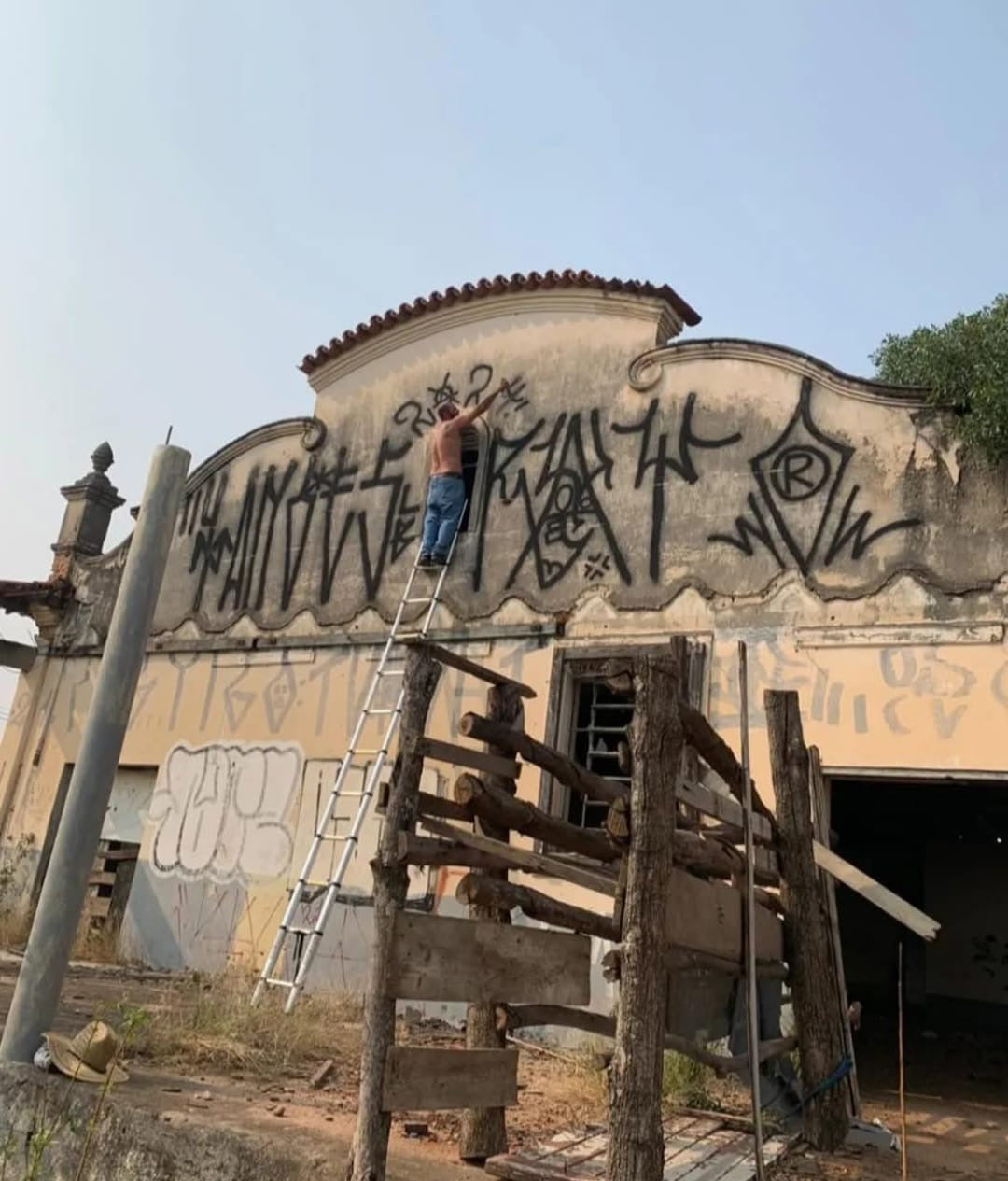
Daniel Carneiro is a father of two from Diadema. Rato is a name that has been going up on São Paulo walls since 1997. He does not ask to be called an artist and he does not ask to be forgiven. Across nearly thirty years of points, cadernos, rolês and grey council paint, what he is describing is not a style. It is a way of refusing to disappear.



[ISC_MEDIA:image-01]
- Subject
- Daniel Carneiro, known as Rato
- Scene
- Pixação, São Paulo
- Started
- Diadema, 1997
- Interviewer
- Victor Franceschi, founder of Ink Society Collective
- Language
- Answers in Portuguese, translated and kept as spoken
The friend who stayed
I started writing on walls in 2004. Rato had been at it since 1997.
I do not remember meeting him, and I could not give you the year. Some time after I started, through friends of friends, probably at a point or on a rolê. That is more or less how it works: the name reaches you before the person does, you read it around the city for months, and at some stage there is a face attached to it. It is not a failure of memory on my part. Nobody is introduced at a point.
What I do remember is everything after. His house. Barbecues. Years of it.
I stopped in 2014. I had started tattooing the year before and could not do both honestly, so I let the rolês go. Rato never left. I tattoo in Dublin now, and I am not going to present that as the next chapter of the same book, because it is not one. I will come back to that at the end.
This is his story, not mine. I sent him nineteen questions in September 2026 and he answered them out loud, talking rather than writing, which is why his Portuguese reads the way it does below. It is edited for length and for nothing else.
Daniel and Rato
“Eu me chamo Daniel Carneiro Moreira da Silva. Nasci em Apucarana, no Paraná. Sou pai de dois filhos, um de 21 e um de 15 anos. O Rato é uma figura da pixação de São Paulo. Comecei lá em Diadema.”
“My name is Daniel Carneiro Moreira da Silva. I was born in Apucarana, in Paraná. I’m the father of two kids, one twenty-one and one fifteen. Rato is a figure in São Paulo pixação. I started in Diadema.”
He introduces himself in two halves and does not pretend they are the same person. Daniel has an ID and two sons. Rato is a name that goes up on walls. The distance between the two is not a disguise, it is the basic architecture of the thing.
It started around 1997.
“Comecei fazendo umas tags de cera. Já olhava uns pixos nos muros, os pixos das antigas de Diadema: Vikings, Six, Distrito, Refém, Rivais... Os caras que eram de lá.”
“I started out doing wax tags. I was already looking at the pixos on the walls, the old Diadema ones: Vikings, Six, Distrito, Refém, Rivais... the guys who were from there.”
Note what he was doing before he was writing: reading. A kid learning the alphabet of his own neighbourhood off the walls, one crew name at a time.
[ISC_MEDIA:image-02]
A word about the letter x
The spelling in this article is deliberate. Pixação with an x, not pichação with ch.
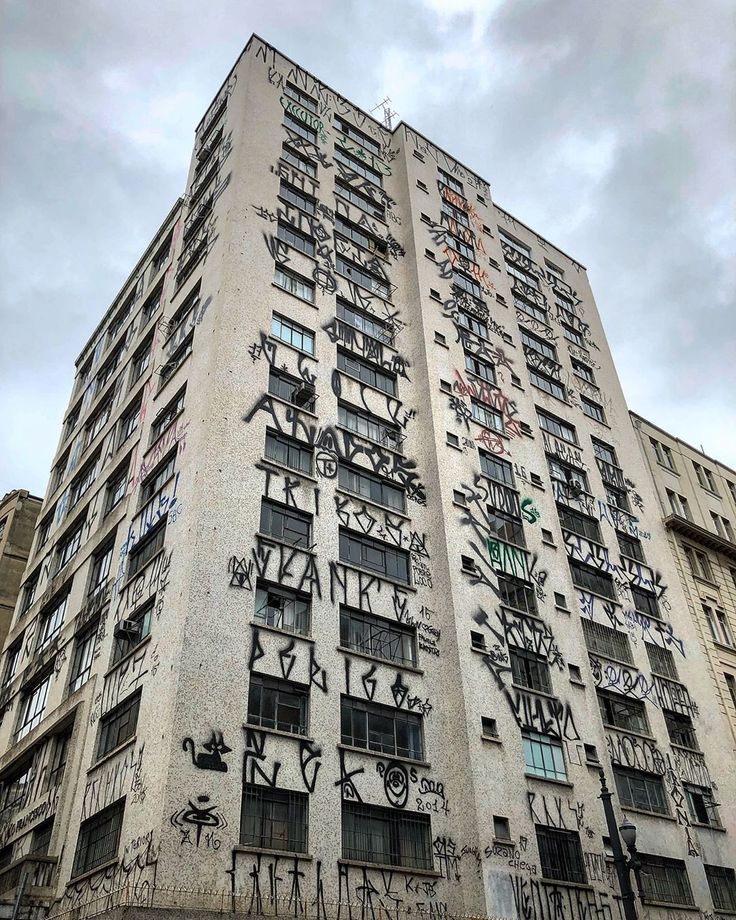
This is not a typo and it is not stylisation. Writers inside the movement separate the two: pichação is legible scrawl, a protest slogan, a phone number, a name daubed on a wall. Pixação is the coded São Paulo script, a rectilinear, angular alphabet that a non-participant is not supposed to be able to read. Researchers documenting the practice make the same distinction. Rato has spent close to thirty years inside the second thing.
The lettering itself has a documented history: a monochrome, straight-edged, vertically compressed alphabet that consolidated in São Paulo in the early 1980s, after the practice migrated south from Rio in the late 1970s. Its formal influences are the ones you would expect from teenagers in that decade, punk and heavy metal record sleeves, and the hard-edged logotypes on them.
If that sounds like design history, it is, and it is worth saying plainly: this is a written language with a lineage, not scribble. A fifteen-year-old in Diadema in 1997 was learning an alphabet other people had already built.
This is published by a tattoo studio, and the reason is not craft. It is that the person who asked the questions came from the same place he did.
“Aparecer de uma forma oculta”
Ask him what the culture actually is and he does not reach for art vocabulary. He reaches for a paradox.
“A cultura da pixação é a gente querer aparecer de uma forma oculta. É a pessoa olhar e falar: ‘Nossa, olha quem foi que fez. Como é que subiram? Como é que fizeram isso do lado de uma delegacia? Como é que subiram naquele prédio?’”
“Pixação culture is us wanting to show up in a hidden way. It’s someone looking and saying: ‘Wow, look who did that. How did they get up there? How did they do that next to a police station? How did they climb that building?’”
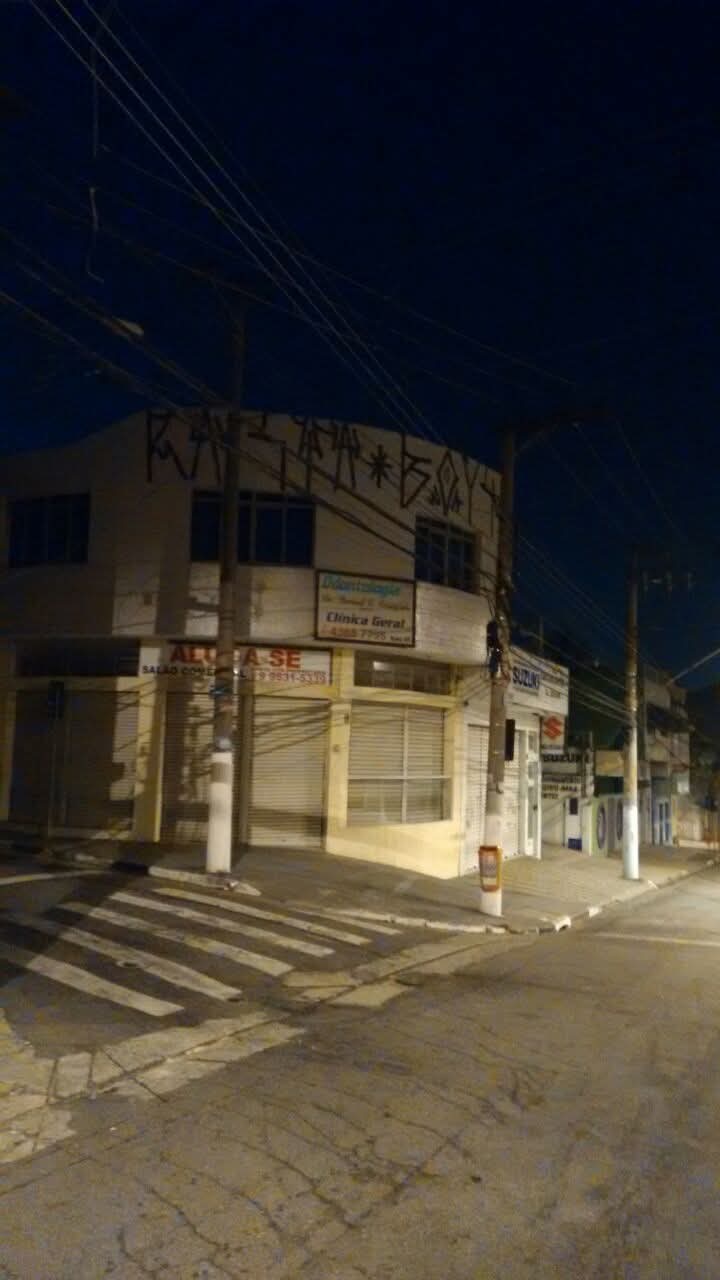
The mark is public and the maker is not. The audience that matters is not the general public at all, it is the small number of people who can read the name, know the building, and understand exactly what it cost to get up there. Everyone else just sees black letters.
[ISC_MEDIA:image-03]
The point
Before the internet, the culture had to meet somewhere.
“Antigamente não tinha internet, não tinha celular. Tinha os points, onde o pessoal se encontrava pra marcar o rolê, trocar folha, bater um papo. Ia pessoal da Zona Sul, Zona Oeste, Zona Leste.”
“Back then there was no internet, no mobile phones. There were the points, where people met up to arrange the rolê, swap sheets, have a chat. People came from the South Zone, the West Zone, the East Zone.”
A point is a fixed meeting place on a fixed night of the week. It did the work that a group chat does now, and several things a group chat cannot: it put strangers from opposite ends of a city of twenty million in the same doorway, and it made you show your face.
Rato calls the point “a thing from the old days.” That is worth sitting with. The infrastructure that built the friendships he now names as the most valuable thing he got out of all this is the part that technology replaced.
VICTOR
I recognised the exact shape of this years later, at a tattoo convention. People turning up to see each other, swapping small things with their names on them, asking questions, going out afterwards. Nobody in that room would call it a point. It is a point.
The notebooks
At the point, you sign.
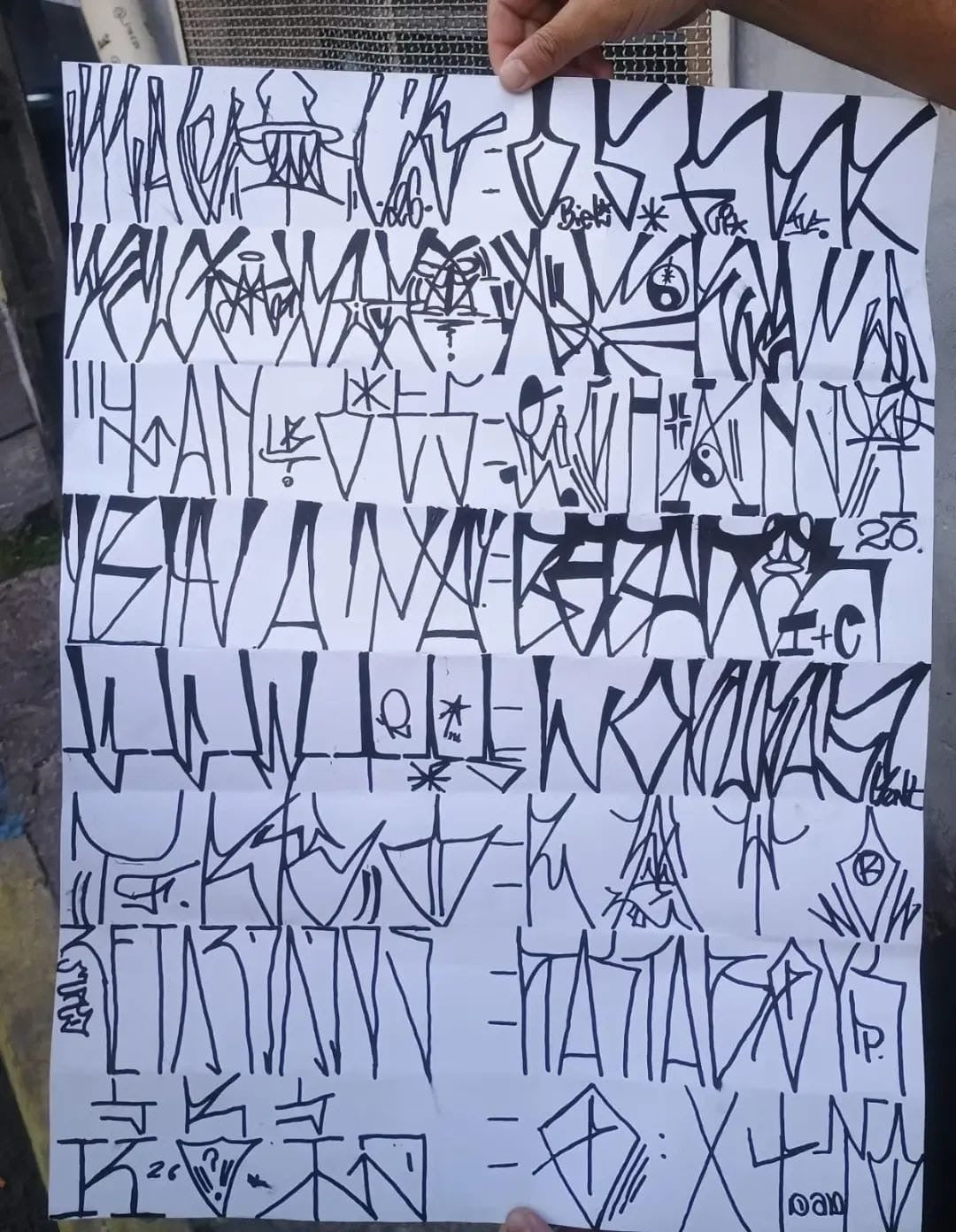
“Os cadernos e as folhinhas são uma forma de admirar o pixo da pessoa. Também representam que você encontrou aquela pessoa, que você conheceu ela. É uma memória viva, assim como as próprias escritas.”
“The notebooks and the loose sheets are a way of admiring someone’s pixo. They also stand for the fact that you met that person, that you knew them. It’s a living memory, the same as the writing itself.”
A caderno is a paper archive of a social network, kept by hand, before anyone called it that. Every signature is a dated record that two people were in the same room. Some of the people in those books are dead. Some stopped. Some are still going. The notebook does not distinguish, it just holds the night it was signed.
[ISC_MEDIA:image-04]
The rolê
The word does not translate. A rolê is the outing, the movement, the whole night, of which the painting is one part and often the shortest.
“O rolê de pixação é uma parada muito louca, porque é tudo planejado. Porém, a gente não sabe o que vai acontecer no rolê: quem vai trombar, como vai ser, o que vai acontecer.”
“A pixação rolê is a mad thing, because it’s all planned. But we don’t know what’s going to happen on the rolê: who you’ll run into, how it’ll go, what’ll happen.”
Planned and unknowable at the same time. He describes nights that start at midnight and finish at seven in the morning, crossing to neighbourhoods on the other side of the city.
Then there is the one he cannot leave out.
“O rolê mais marcante foi quando eu vim na janela, próximo à Rodovia dos Imigrantes. Eu acabei de fazer o visual e passou um embate... Aí eu pulei da janela. Tinha uns sete metros. Pulei da janela, depois levei um tapa na orelha. Isso é inesquecível.”
“The most memorable rolê was when I came out on the window ledge, near the Imigrantes motorway. I’d just finished the visual and a police patrol came past... So I jumped from the window. It was about seven metres. I jumped from the window, and then I took a slap round the ear. That’s unforgettable.”
He tells it flat, the way people tell stories they have told before. He does not dramatise the drop and he does not dwell on the slap. It is the only moment in the interview where the price of the thing surfaces, and he moves past it in a sentence.
Asked what pulls someone into that in the first place, he gives the most honest answer available.
“É a mesma coisa de uma pessoa que gosta de escalar, sabe? Um alpinista. Ele sente adrenalina e gosta daquilo na hora, no momento. Naquele momento, você não vê nada. Só vê a arte no muro.”
“It’s the same as someone who likes climbing, you know? A mountaineer. He feels adrenaline and he likes it right then, in that moment. In that moment, you don’t see anything. You just see the art on the wall.”
[ISC_MEDIA:image-05]
The parties
There is a whole social calendar most people never hear about: invitations signed by hand, crews and grifes, collective labels that several marks share, barbecues, music, families.
“É pra mostrar que tá na rua, que tá viva, chamar os amigos e também convidar quem não conhece pra conhecer.”
“It’s to show that it’s out on the street, that it’s alive, to call your friends and also to invite people who don’t know it to come and see.”
A party is a status report. If the grife throws one and people come, the name is alive. If nobody comes, that is information too.
[ISC_MEDIA:image-06]
The one rule
Every culture worth the name has a rule that outsiders trip over. This one has atropelo.
“O código aqui no Brasil é: não pode atropelar. Atropelar é fazer em cima do outro. Porque, a partir do momento que eu assumo o risco de fazer, aí vem outra pessoa e faz por cima. Aí é tiração.”
“The code here in Brazil is: you don’t run people over. Atropelar is writing over someone else. Because from the moment I take the risk to do it, then someone else comes and writes over the top. That’s a diss.”
Read the reasoning, not the rule. The prohibition is not about property or aesthetics. It is about risk. Painting over someone’s name is an insult specifically because you did not pay what they paid to put it there.
Trust as a technical requirement
This is the centre of the interview, and he says it in two lines.
“A pixação me ensinou que você precisa confiar na pessoa mesmo. Se não tiver confiança, não tem rolê.”
“Pixação taught me that you really have to trust the person. If there’s no trust, there’s no rolê.”
Not a sentiment. A precondition. On a rolê, someone is holding a ladder, watching a street, or deciding whether to run when a patrol turns the corner. The friendship is not a nice by-product of the activity, the activity does not function without it.
Which is why he refuses to romanticise the outcome.
“A pixação cria amizades muito fortes e também decepções. Às vezes você conhece uma pessoa, bota fé nela, mas você não sabe quem ela realmente é.”
“Pixação creates very strong friendships and also disappointments. Sometimes you meet someone, you have faith in them, and you don’t know who they really are.”
And the distinction he draws next is the one nobody outside would think to make:
“Eu tenho camaradas que eu nunca pixei junto, mas que sempre fiz rolê.”
“I’ve got mates I never actually painted with, but I always went on the rolê with.”
The painting is not the bond. The night is.
Asked what the biggest gift was, after everything:
“O maior presente pra mim foram as amizades.”
“The biggest gift for me was the friendships.”
He will not call it art
This is where the interview stops being comfortable, and it is the best thing in it.
“A pixação, pra mim, é vandalismo mesmo. Tem pessoas que hoje em dia ganham dinheiro com ela, né? Mas aí já é um artista.”
“Pixação, for me, is vandalism, straight up. There are people who make money off it these days, right? But then that’s an artist.”
He is not being self-deprecating. He is drawing a line, and he is putting himself on the far side of it on purpose. The moment the practice is sold, framed, or hung, it becomes something else with a different name. He is not interested in being laundered.
That refusal has a real backdrop. Pixação has been shown in institutions for close to two decades, an unauthorised intervention at the São Paulo Biennial in 2008, Fondation Cartier in Paris in 2010, a European museum survey as recently as 2025. Some pixadores went through that door. Rato is describing the choice not to, and he is describing it without bitterness toward the ones who did.
What he offers instead of “art” is a better word.
“Eu me enxergo como uma reivindicação. De mostrar que tô vivo. Que a periferia tá aí, em meio à sociedade capitalista.”
“I see myself as a claim being made. Showing that I’m alive. That the periphery is here, in the middle of capitalist society.”
[ISC_MEDIA:image-07]
How he reads a city
Nearly thirty years of looking up changes what a street is.
“Eu enxergo a cidade como uma tela, um painel. Existem lugares que é pra você ver, existem lugares que é pros outros ver.”
“I see the city as a screen, a panel. There are places that are for you to see, and places that are for other people to see.”
Two cities on top of each other. The one the advertising is aimed at, and the one addressed to a few thousand people who can read it.
And then the line the whole interview had been walking toward:
“É que a sociedade não quer ver nós fazendo. Ela fecha o olho na hora. Ninguém quer ver o moleque de madrugada, com frio, com medo da polícia, subindo num prédio. Mas no outro dia de manhã, ela é obrigada a ver. O pixo tá lá. É o lado sombrio porque acontece no escuro, mas aparece na luz do dia.”
“It’s that society doesn’t want to see us doing it. It shuts its eyes at the time. Nobody wants to see the kid at four in the morning, cold, scared of the police, climbing a building. But the next morning, it’s forced to look. The pixo is there. It’s the dark side because it happens in the dark, but it shows up in daylight.”
[ISC_MEDIA:image-08]
Two roads out of the same place
Victor Franceschi
[ISC_MEDIA:image-09]
I said at the start that I stopped in 2014, and that I would come back to it. Here is the part I wanted to be careful about.
I did not graduate from pixação. Tattooing is not the grown-up version of it and I am not standing above anybody who stayed. They are two separate things, and the only reason I stopped is that I had started tattooing the year before and could not do both honestly.
They are also not the same size, and I do not want to flatten them into one story.
Tattooing today is mostly read as art. Not everywhere and not by everyone, and I say that as someone heavily tattooed rather than only as someone who tattoos. But it is read.
Pixação is about something else. It is about belonging to the part of society that is shut out. Most of the people in it are humble, hard-working people who the system forgets. In Brazil a minimum wage does not stretch across rent, a supermarket shop, and the water and electricity bills. The state schools their children go to are not what those children deserve. That is the ordinary week, for millions, and almost none of it is visible from outside.
So the name on the building is a protest. It is people rubbing it in society’s face that they exist, that they deserve their place, that they deserve to be heard. This is not a story about a pixador. It is a story about who the pixador comes from.
I left Brazil because climbing out of that is close to impossible there, and I have been building something in Europe instead. It does not make me a former pixador. In my heart I am still one. I still read walls. When I walk through a city I am reading names that most people around me cannot see.
I asked Rato one last question: what he wanted the reader to take away, about pixação and about who Rato is. He has answered it better than anything I have written here, so this is where I get out of the way.
The last word
“Não quero que entendam. Quero que respeitem.”
“I don’t want them to understand. I want them to respect it.”
“Pixação é a caligrafia de quem nunca teve voz e é o único arquivo da periferia que a prefeitura não consegue editar. O museu apaga, a tinta cinza da prefeitura apaga, e a gente volta. Enquanto os cara paga milhões pra colocar nome em outdoor vendendo carro que a gente nunca vai comprar, nós escala prédio de madrugada de graça só pra dizer que existiu.”
“Pixação is the handwriting of people who never had a voice, and it is the only archive of the periphery the city council cannot edit. The museum wipes it, the council’s grey paint wipes it, and we come back. While those guys pay millions to put their name on a billboard selling a car we are never going to buy, we climb a building at four in the morning, for free, just to say we existed.”
“O Rato não é artista, não é personagem, não é vândalo. Rato é o apelido que a rua me deu porque eu vivo onde ninguém quer olhar: no esgoto, no topo do prédio abandonado, na quebrada.”
“Rato is not an artist, not a character, not a vandal. Rato is the nickname the street gave me, because I live where nobody wants to look: in the sewer, on top of the abandoned building, in the quebrada.”
“Eu sou só o moleque de baixo que entendeu que se eu não escrever meu nome no muro, que é o único papel que deixaram pra gente, ninguém vai escrever por mim. Se meu nome tá sujo na parede, é porque minha vida inteira sempre foi tratada como sujeira também. Pixar não é sobre ser bonito. É sobre existir.”
“I am just the kid from the bottom who worked out that if I do not write my name on the wall, which is the only paper they left us, nobody is going to write it for me. If my name is dirty on the wall, it is because my whole life has always been treated like dirt too. Pixar is not about being beautiful. It is about existing.”
Pixação is a criminal offence in Brazil. This article documents a culture through the account of someone who has lived inside it for nearly thirty years. It is reporting, not encouragement.
Image credits
Photographer credits to be confirmed before publication. Images are to be uploaded only once Daniel 'Rato', any identifiable people, and the photographers have approved their use.
Last reviewed: September 2026